# How Breaking Words Changed the Way My Students Approach Language
Many students struggle with the gap between decoding and comprehension. A teacher at TeachThought discovered that students often pronounce words correctly during phonetic exercises but cannot explain meaning when asked directly. This creates a false sense of reading proficiency.
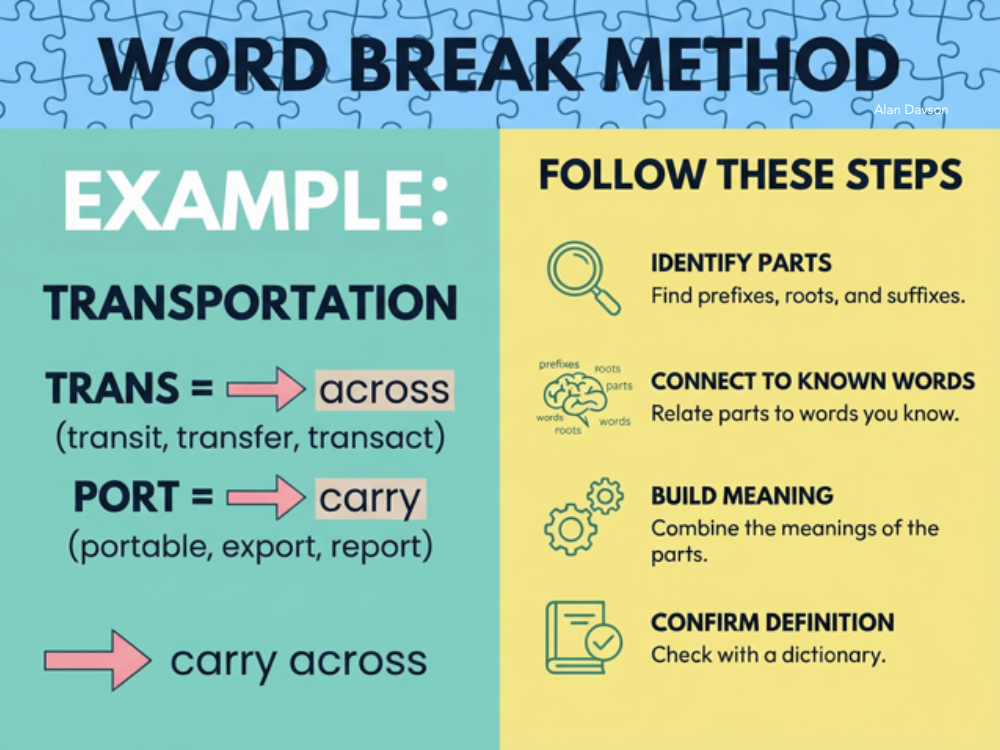
The solution involves explicit instruction in morphology, the study of word structure and formation. By teaching students to break words into component parts—prefixes, roots, and suffixes—educators help them build meaning systematically rather than relying on context alone.
A student who learns that the prefix "un-" means "not" and "happy" is an emotional state can independently decode "unhappy" and understand its meaning. This approach transfers to unfamiliar words. Instead of freezing when encountering "uncomfortable," students apply their knowledge of "un-" and "comfort" to unlock meaning.
Research in literacy instruction supports morphological awareness as a predictor of reading comprehension and vocabulary growth. Studies show students who receive morphology training improve vocabulary retention and reading fluency more than peers taught through context-only methods.
The practical application differs by grade level. Elementary teachers might start with common suffixes like "-ing" and "-ed." Middle and high school teachers can tackle Latin and Greek roots that underpin academic vocabulary in science, history, and literature.
Breaking words into parts also addresses a real classroom observation. Students who decode without understanding miss the point of reading entirely. They complete worksheets and pass fluency checks while remaining functionally illiterate in comprehension.
Teachers implementing this approach report reduced student anxiety around unfamiliar vocabulary. When students have a system for attacking new words rather than guessing or shutting down, engagement increases. The strategy works across reading levels because it gives all learners a concrete process.
This method requires intentional lesson design and time investment upfront. Teachers must explicitly teach word families, model