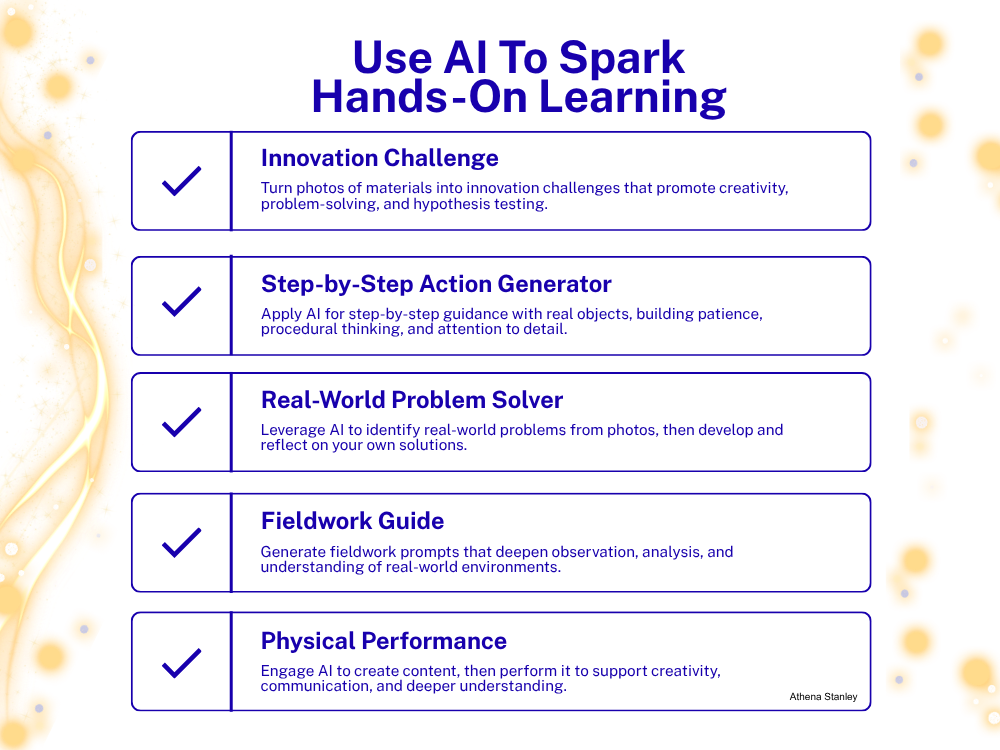
# From Screen to World: AI Tools for Hands-On Learning in K-12
Teachers are finding practical ways to integrate artificial intelligence into classrooms by connecting digital tools to real-world problem-solving. One approach involves having students photograph their school, home, or community environments, then use AI to identify problems without receiving immediate solutions. This method keeps students active in the analysis phase rather than passive recipients of answers.
The strategy reflects a broader shift in how educators approach AI implementation. Rather than using AI for automated grading or content delivery, teachers leverage it as a thinking partner that prompts deeper investigation. Students photograph a crowded hallway, a pothole in a parking lot, or litter in a park, then ask AI to describe what problems exist. The tool identifies issues without proposing fixes, leaving room for student reasoning and creativity.
This approach serves multiple learning goals. Students develop observational skills by scanning environments critically. They practice asking precise questions to get useful information. They engage in problem definition before problem-solving, a skill that research shows improves solution quality. The hands-on element keeps learning tied to tangible contexts rather than abstract exercises.
The method also builds agency. Students investigate places they already inhabit, giving them ownership over what they study. A student noticing poor lighting in a stairwell transforms that observation into a learning opportunity rather than accepting it as background noise.
Schools using these techniques report that students move between digital and physical work seamlessly. A student might photograph a community garden with spotty water access, ask AI to identify the problem, then conduct interviews with gardeners, research irrigation systems, and prototype solutions using materials in the school's makerspace.
TeachThought's framework presents five specific strategies for this type of integration, though the core principle remains constant. By positioning AI as a diagnostic tool rather than a solution provider, teachers preserve the cognitive work for students. The technology surfaces patterns and problems.