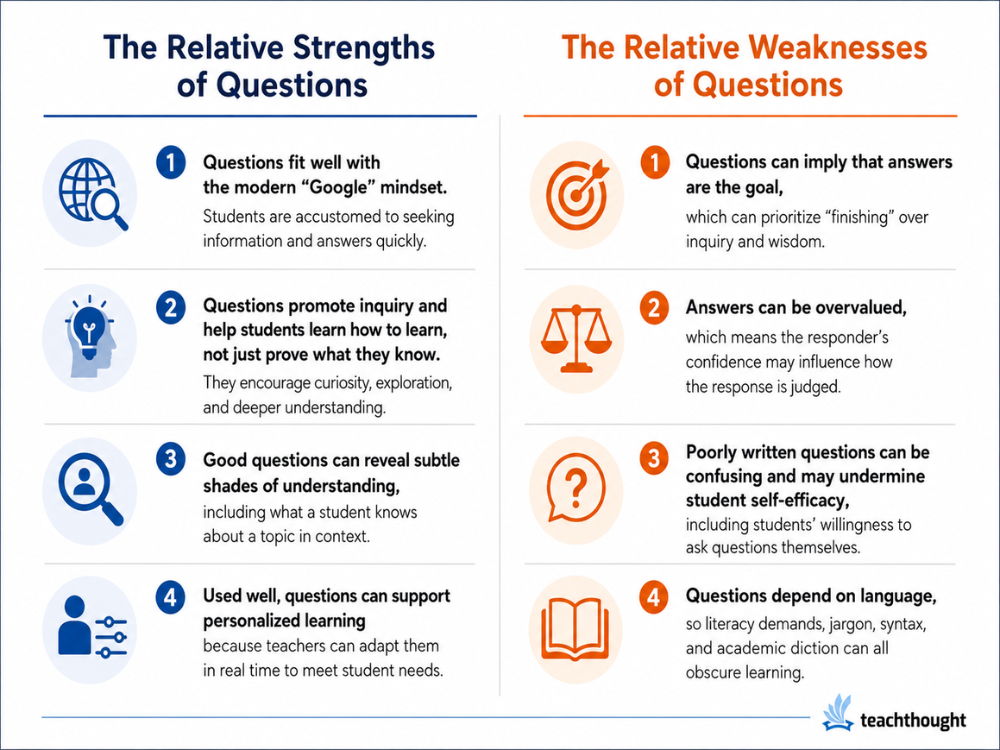
# Questioning in the Classroom: Understanding Over Ignorance
TeachThought has released an updated guide that reframes how educators should view student questions. The resource treats questions as evidence of learning progress rather than gaps in knowledge.
The guide's core premise shifts perspective on classroom questioning. Questions signal that students are actively thinking about material and recognizing what remains unclear. This contrasts with traditional views that treat questions as admissions of failure.
The approach emphasizes that effective questioning builds understanding. When students ask questions, they demonstrate metacognitive awareness. They can identify the boundaries of their knowledge and articulate what they need to learn. This capacity matters more than already knowing answers.
The guide addresses both student-initiated questions and teacher-led questioning strategies. For instructors, the resource likely covers how to design questions that push thinking deeper, prompt analysis, and encourage students to build connections between concepts. For learners, it validates the act of asking questions as part of legitimate intellectual work.
This framework aligns with learning science research showing that struggle and productive confusion advance understanding. Students who ask questions engage in active learning. They move beyond passive receipt of information into dialogue with material.
The updated guide comes as educators refine best practices around classroom discourse. Secondary and higher education institutions increasingly recognize that dialogue quality predicts learning outcomes. Questions function as tools for both students and teachers to assess comprehension, identify misconceptions, and deepen analysis.
By positioning questions as signs of understanding, TeachThought's guide gives students permission to speak up without shame. It also challenges teachers to view questioning time as instructional time, not interruption. The resource offers practical value for educators at multiple grade levels seeking to build cultures where intellectual curiosity thrives and confusion becomes a productive part of learning.