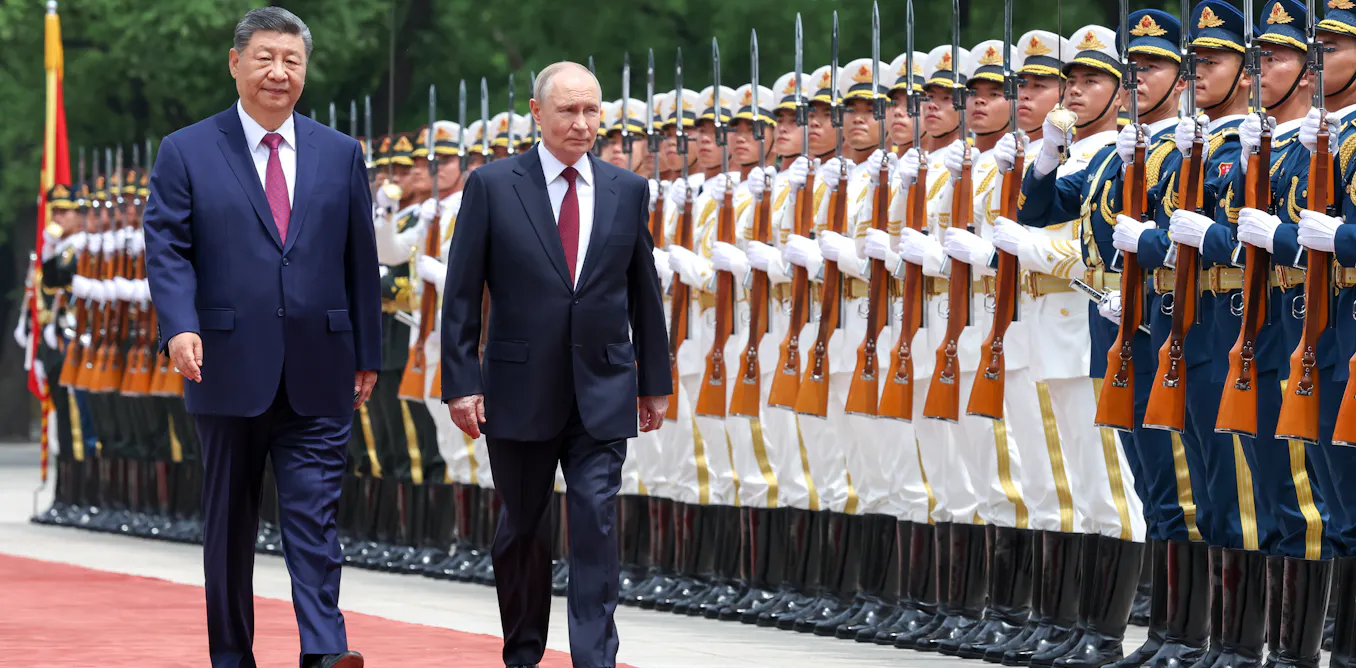
# Xi and Putin tout 'new type' of world order in Beijing—but is their alliance really that strong?
Chinese President Xi Jinping and Russian President Vladimir Putin have repeatedly framed their partnership as a revolutionary "new type" of world order that challenges Western dominance. Yet the relationship remains fundamentally asymmetrical, with China holding the upper hand in dictating the pace and scope of cooperation.
Russia depends heavily on China economically and diplomatically. Since Western sanctions intensified following Russia's invasion of Ukraine, Moscow has become increasingly reliant on Beijing for trade, investment, and international legitimacy. China, however, carefully calibrates its commitment. It provides crucial economic lifelines without fully endorsing Russia's military actions or aligning itself so closely that it invites similar sanctions.
The two nations share common grievances against the United States and its allies. Both resist what they view as Western attempts to impose democratic values and maintain global hegemony. This shared opposition creates a tactical alliance rooted in mutual interest rather than ideological alignment or deep trust.
However, several tensions undermine the partnership's strength. China prioritizes stability and economic growth, while Russia's aggressive foreign policy carries risks China wants to avoid. Russia's demographic decline and limited technological capacity make it a junior partner in the relationship. Central Asia, historically within Russia's sphere of influence, increasingly falls under Chinese economic control through Belt and Road initiatives.
The partnership lacks the institutional depth and mutual commitment of Cold War-era alliances. Neither nation formally guarantees the other's security. They maintain separate interests in critical regions, particularly regarding influence in Central Asia and the Arctic.
Beijing's approach reflects strategic pragmatism. China gains leverage over a weakened Russia while avoiding the costs of direct confrontation with the West. This calculated distance allows China to pursue its own objectives without being dragged into conflicts that might damage its economy or global relationships.
The "new type" of