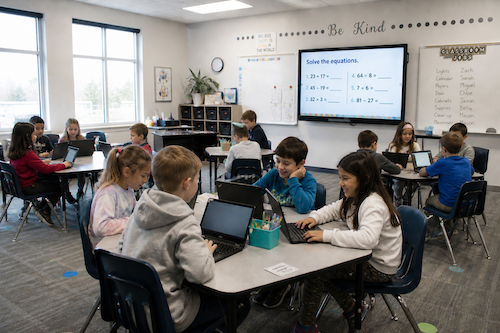
Students arrive at math class already struggling because instruction ignores how brains actually learn math, according to emerging education research. The traditional sequence of teaching vocabulary, demonstrating procedures, then assigning practice works for some students but leaves many behind before meaningful learning even begins.
Research in cognitive science and neuroscience reveals that this conventional approach conflicts with how the brain processes mathematical concepts. Students need opportunities to engage with mathematical thinking through exploration and problem-solving before formal instruction introduces terminology and procedures. When educators flip this sequence, students develop deeper conceptual understanding rather than memorizing disconnected steps.
The problem starts early. Young students who haven't yet built intuitive number sense struggle when teachers immediately introduce symbolic notation and algorithmic procedures. These students lack the mental foundations to attach meaning to what they're being asked to do. Without that foundation, practice becomes frustrating repetition rather than reinforcement of understanding.
Brain-based learning research shows that students learn math most effectively when instruction aligns with cognitive development. This means starting with concrete experiences, moving to representational models, and finally reaching abstract symbols. When schools skip the concrete stage and jump directly to abstract procedures, many students fall behind.
Different students also need different amounts of time to build conceptual understanding. A one-size-fits-all pace disadvantages slower processors and those with gaps in prerequisite knowledge. By the time remediation happens, students have already internalized math anxiety and developed negative self-concepts about their math abilities.
Aligning math learning with how brains actually work requires rethinking instructional sequences in classrooms. Teachers need time and professional development to implement approaches grounded in cognitive science rather than tradition. Schools must also assess conceptual understanding rather than procedural fluency alone, allowing educators to identify where students lack foundational thinking before they fall further behind.
When math instruction matches brain science, access to success expands for every student, not just those who naturally absorb procedural