# When STEM Lessons Are Too Easy, Students Stop Thinking
Teachers often confuse activity with learning. Students who stay busy during STEM lessons appear engaged, but ease alone does not build thinking skills. Research shows that learners stop processing information deeply when tasks feel effortless.
The problem runs deeper than simple boredom. When STEM instruction lacks appropriate challenge, students shift into autopilot mode. They complete worksheets, follow procedures, and produce correct answers without wrestling with concepts. This passive completion looks productive on the surface but leaves critical thinking untouched.
Cognitive load theory explains the mechanism. Students need friction. Tasks pitched too low don't activate the mental struggle required for learning. Brain imaging studies show that challenging work engages prefrontal regions tied to reasoning and problem-solving. Easy work activates only surface-level processing.
The stakes matter in STEM fields. Mathematics and science demand reasoning over procedure. A student who can execute a formula without understanding its logic faces serious gaps when encountering novel problems. Engineers, scientists, and technicians must troubleshoot unfamiliar situations. Rote competence does not transfer.
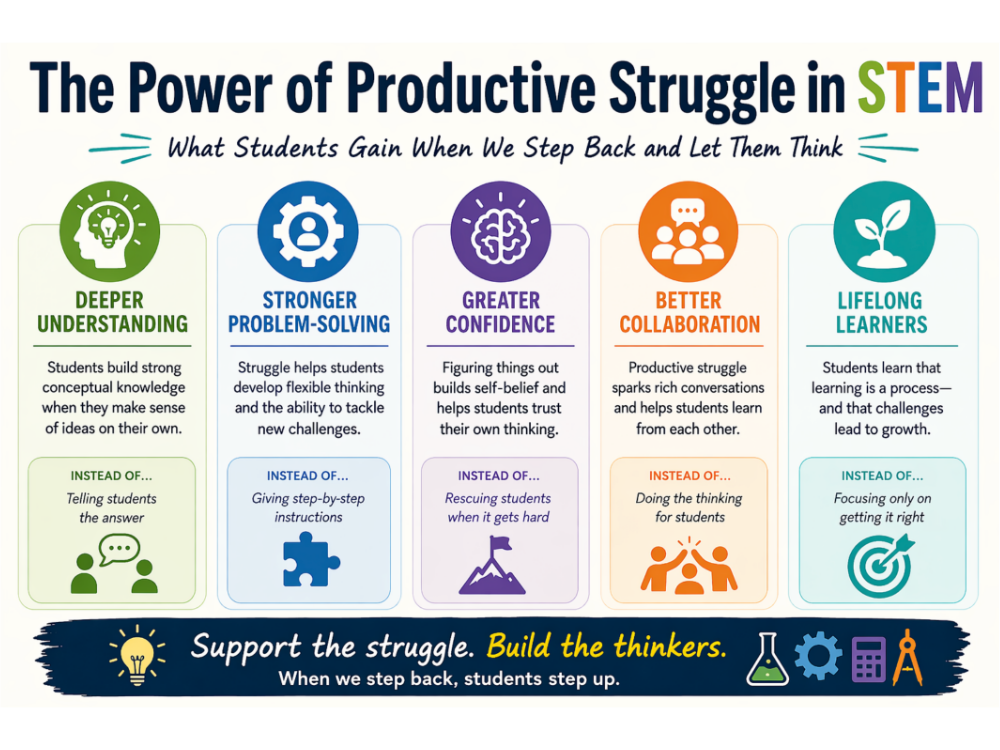
Effective STEM teaching requires deliberate struggle. Teachers should design lessons where students encounter problems they cannot immediately solve. This friction drives deeper encoding. Students who fumble through a physics problem, test hypotheses that fail, and revise their thinking build conceptual knowledge that persists.
The engagement trap catches many educators. Colorful activities and smooth operations feel like success. But behavioral engagement differs from cognitive engagement. A student can participate actively while thinking minimally.
Reframing classroom norms helps. Teachers should expect and normalize productive struggle. Students need language to describe difficulty as learning, not failure. "You're confused because this idea is complex" sends different signals than "You got it wrong."
STEM instruction improves when teachers raise the bar intentionally. This means