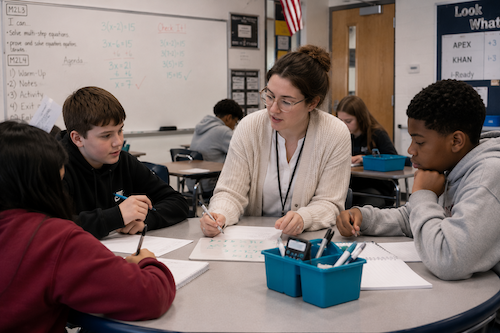
American math classrooms often prioritize procedural fluency over conceptual understanding, leaving students unable to explain why methods work even when they execute them correctly. This gap between doing and understanding represents a fundamental challenge in U.S. math instruction that researchers and educators are working to address by studying what international classrooms do differently.
The anecdote from a teacher whose advanced student could solve complex equations but couldn't explain the reasoning behind them highlights a persistent problem. Students memorize algorithms and follow steps without grasping underlying mathematical principles. This approach produces students who perform calculations competently but struggle when facing unfamiliar problems or asked to justify their solutions.
International math programs, particularly in East Asia, prioritize the inverse. Countries like Japan, Singapore, and South Korea emphasize deep conceptual understanding before moving to procedural practice. Teachers in these systems spend considerable class time exploring why mathematical methods work through multiple representations, class discussion, and problem-solving approaches. Students develop mental models that allow them to adapt strategies to new situations.
U.S. classrooms increasingly recognize this shortcoming. Research on math instruction demonstrates that when teachers balance procedure with explanation, student performance improves across diverse student populations. The challenge lies in implementation. American teachers often face time constraints, curriculum pressures, and accountability systems that reward computational speed over reasoning.
Effective reforms combine elements from international models with American strengths. Teachers benefit from professional development focused on mathematical reasoning, not just content delivery. Curricula need redesign to build conceptual foundations before introducing shortcuts. Assessment practices must shift beyond computation problems to include open-ended reasoning tasks.
Some districts have adopted these approaches with measurable results. Schools incorporating deeper conceptual instruction alongside procedural practice see gains in student achievement and confidence. Students develop resilience when facing novel problems because they understand principles rather than merely following recipes.
The evidence is clear. Math instruction works best when students grasp why methods function, not just how to