# AI Tools Help Students Move From Screens to Real-World Problem Solving
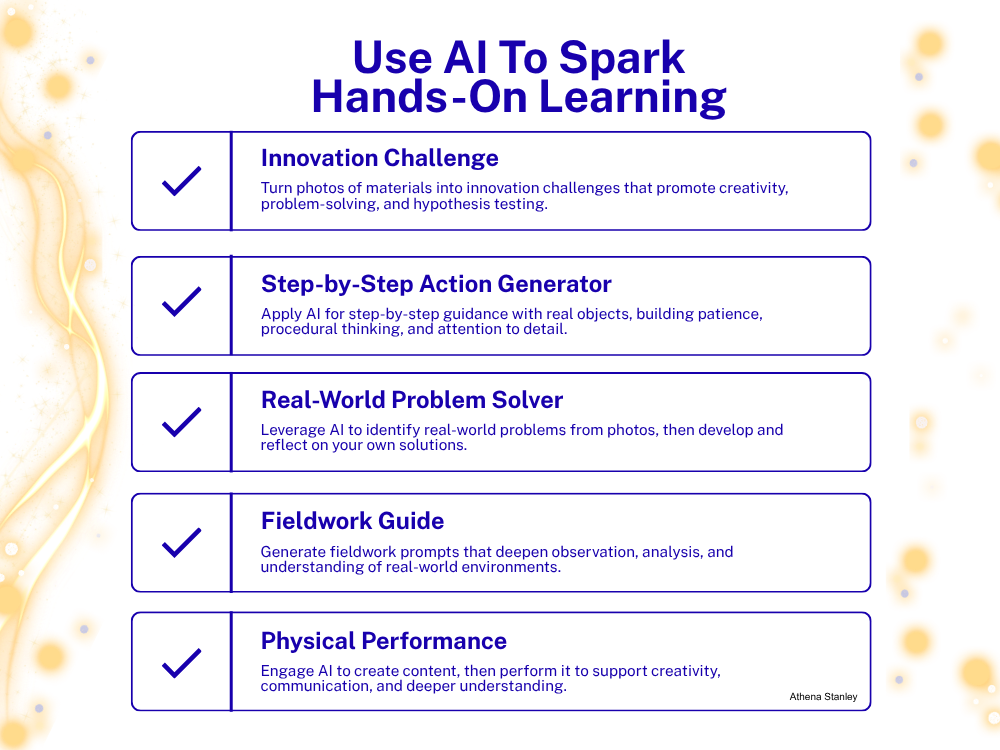
Teachers are using artificial intelligence to shift students' attention from digital devices to tangible challenges in their physical surroundings. One approach asks students to photograph their school, home, or community environment, then prompt AI tools to identify existing problems without providing ready-made solutions.
This strategy, outlined by TeachThought, pushes back against passive screen time by anchoring AI use to observable reality. Students capture images of actual spaces, then engage AI as an analytical partner rather than an answer engine. The process requires students to think critically about what problems their AI tool identifies, why those issues matter, and how they might address them using hands-on methods.
The photo-and-identify method represents a broader shift in K-12 AI integration. Rather than treating AI as a replacement for thinking, educators increasingly frame these tools as catalysts for deeper engagement with the physical world. Students move beyond typing prompts into a screen. They observe, document, question, and plan.
This approach also surfaces community-specific challenges that generic curriculum materials miss. A student photograph might reveal sidewalk cracks, lack of shade in a playground, or accessibility barriers near a school entrance. These observations become authentic starting points for design projects, service learning, or environmental science investigations.
The effectiveness depends on how teachers structure the workflow. Simply asking AI to "find problems" risks surface-level responses. Teachers who add constraints such as "identify only solvable problems for students your age" or "focus on problems affecting people with disabilities" deepen the learning.
Early implementations show promise in engaging students who find traditional worksheets disconnected from real life. The combination of photography, AI analysis, and physical investigation creates multiple entry points for different learners. Visual learners benefit from the photography component. Analytical learners engage with AI interpretation. Hands-on learners drive the solution phase.