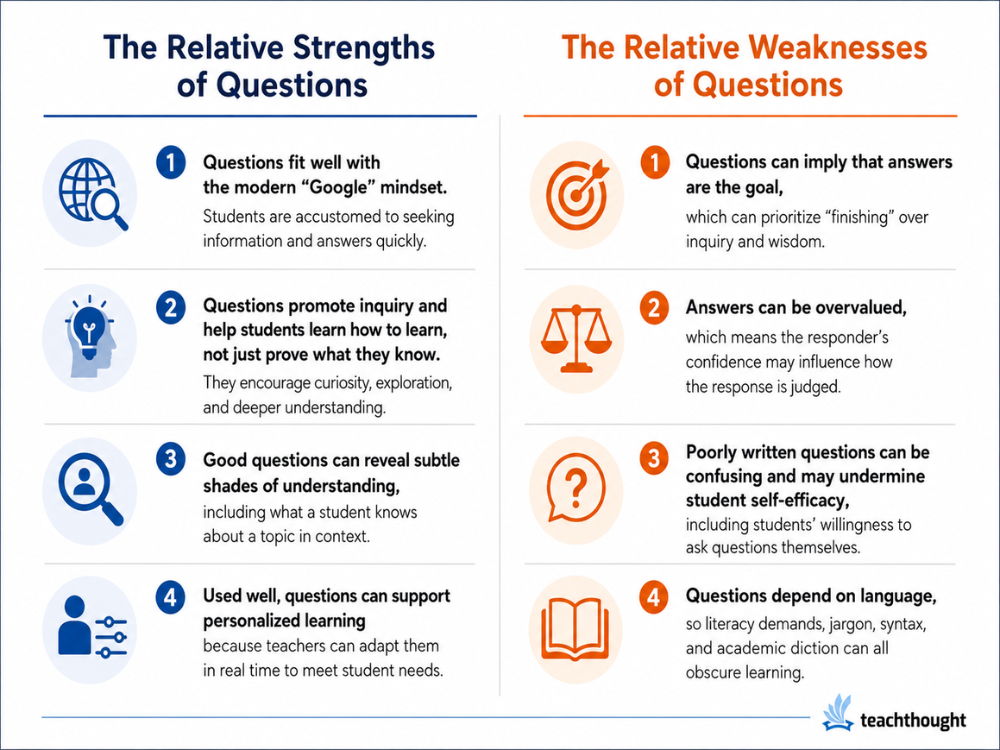
# An Updated Guide To Questioning In The Classroom
TeachThought has released updated guidance on classroom questioning that reframes how educators should view student questions. Rather than treating questions as indicators of gaps in knowledge, teachers should recognize questioning as evidence of active thinking and comprehension.
The guide positions questions as cognitive tools. When students ask questions, they demonstrate they have engaged enough with material to identify what they do not yet understand. This metacognitive skill—knowing what you don't know—forms a foundation for deeper learning.
The framework shifts classroom culture away from punishment for not knowing and toward valuing inquiry. Students who ask questions show they have processed information, recognized inconsistencies or gaps, and formulated language to address those gaps. These are hallmarks of high-order thinking.
The guide applies to multiple classroom contexts. Teachers can use questioning as a formative assessment tool, understanding which concepts students grasp and where confusion exists. Students can learn to ask better questions through modeling and practice, moving from surface-level clarification ("Can you repeat that?") to deeper analytical queries ("Why does this approach work better than the alternative?").
Creating space for questions requires intentional classroom design. Teachers need to establish psychological safety so students risk asking without fear of judgment. They need to allocate time for questions rather than rushing through content. They need to respond to questions in ways that validate the thinking behind them, even when the answer is "I don't know. Let's find out together."
This approach serves students across achievement levels. Struggling students gain permission to seek help through questions. Advanced students develop the habit of interrogating material rather than accepting it passively. All students practice articulating their thinking, a skill essential for academic success and professional communication.
TeachThought's updated guide reflects broader research on learning science and growth mindset, suggesting that questioning should be normalized as part of classroom routine rather than viewed as disruption.