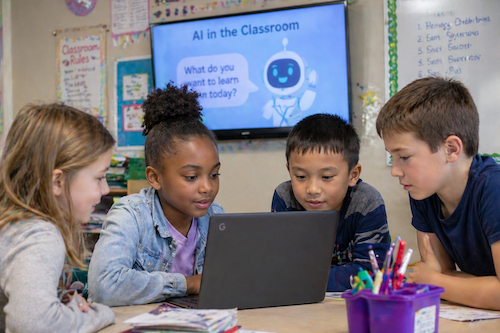
Schools across the country lack consistent policies for artificial intelligence use in classrooms, leaving individual teachers to make their own decisions about when and how to deploy AI tools. This fragmented approach creates confusion about what AI actually means in educational settings and raises questions about equity, effectiveness, and student learning outcomes.
Without district-level or state-level guidance, teachers operate in a vacuum. One educator might use AI writing assistants to help students generate essay drafts. Another blocks the same tools entirely, viewing them as cheating devices. A third implements AI for personalized math tutoring. The result: identical students in the same district experience radically different relationships with AI technology depending on which classroom they enter.
This inconsistency matters because AI in schools involves real tradeoffs. Tools like ChatGPT and Claude can help struggling readers access material, provide instant feedback on assignments, and adapt lessons to individual learning speeds. But they also raise legitimate concerns about plagiarism, over-reliance on automated answers, and displacement of critical thinking. Teachers need clear frameworks to navigate these tensions.
Research on AI in education remains limited. Most schools have not yet established assessment mechanisms to measure whether AI tools actually improve learning. Some districts are beginning to develop guardrails, but progress remains slow and uneven. A teacher in San Francisco might follow comprehensive AI literacy guidelines while a colleague in rural Georgia operates with zero formal direction.
The absence of shared structures also creates access problems. Well-resourced schools can purchase premium AI platforms and provide training. Under-resourced schools rely on free tools, sometimes without adequate support for teachers or students. Over time, this divergence widens achievement gaps rather than narrowing them.
Educators and administrators recognize that AI will shape classrooms for decades. But without coordinated policies, schools are essentially running thousands of separate experiments with no systematic way to learn from results. Students deserve consistency in how schools approach transformative technology. That requires district and