# What Is Whataboutism? A Rhetorical Tool Students Need to Recognize
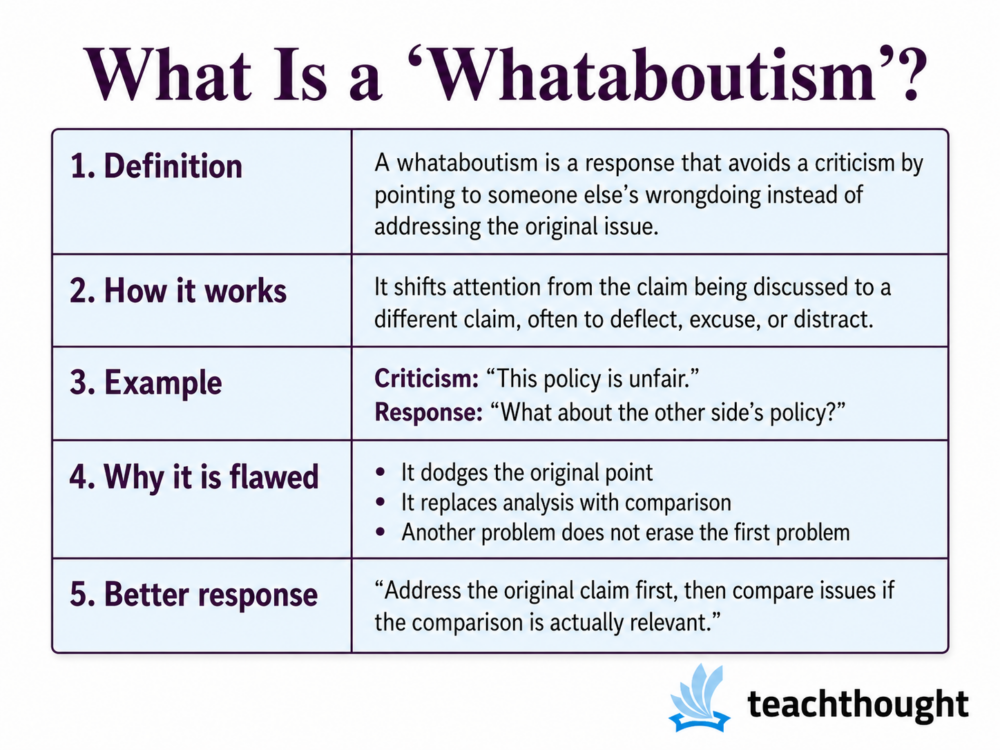
Whataboutism is a debating tactic that sidesteps direct answers by raising an unrelated or tangential issue instead. When confronted with a criticism or claim, someone practicing whataboutism responds with "What about..." and pivots to a different topic altogether. This deflection prevents meaningful engagement with the original argument.
The term gained prominence during Cold War debates. Soviet officials, when criticized for human rights violations, would respond by pointing to problems in Western nations. The pattern repeated across decades: rather than address the specific charge, they redirected blame elsewhere.
In modern contexts, whataboutism appears in political discourse, social media arguments, and everyday conversations. A student might respond to a teacher's critique of incomplete homework by asking, "What about when you didn't grade our tests on time?" A politician accused of policy failures might counter with criticisms of an opponent's record.
TeachThought identifies whataboutism as a rhetorical deflection that educators should help students recognize and resist. Teaching critical thinking requires students to understand how arguments work. When they spot whataboutism, they learn to distinguish between legitimate counterarguments and diversionary tactics.
Legitimate counterargument differs from whataboutism. A counterargument directly engages with the claim and offers evidence or logic against it. Whataboutism simply changes the subject. Recognizing this difference builds stronger reasoning skills.
Media literacy programs increasingly highlight whataboutism because it undermines productive debate. Students exposed to news and social media encounter this tactic regularly. Identifying when arguments use deflection rather than evidence helps them evaluate information more carefully.
Schools teaching debate, argumentative writing, and media literacy benefit from explicit whataboutism instruction. Teachers can show examples from news coverage, political speeches, and online discussions. Students