# Breaking Words Open: A Teacher's Strategy for Deeper Reading Comprehension
A classroom strategy of breaking words into component parts is helping students move beyond simple phonetic decoding to genuine comprehension. Teachers using this approach report that while many students can sound out unfamiliar words, they often lack the ability to explain what those words actually mean.
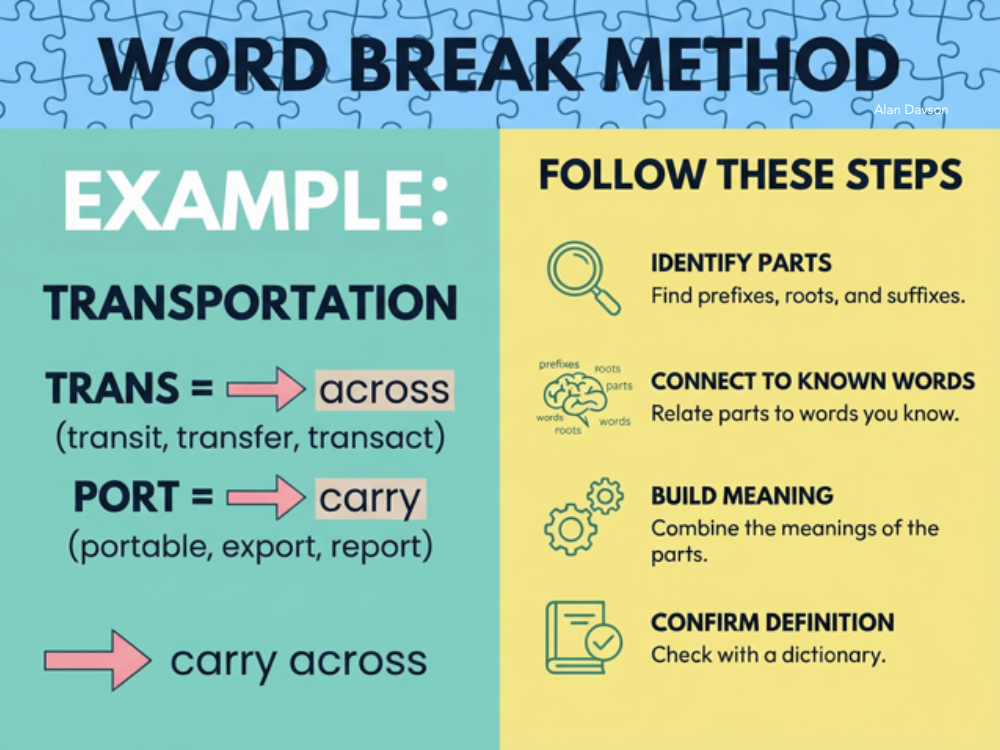
The method involves teaching students to recognize word roots, prefixes, and suffixes as meaning-making units. When a student encounters "unhappiness," for example, the teacher guides them to identify "un" (not), "happy" (feeling), and "ness" (a state or condition). This structural analysis becomes a bridge between pronunciation and understanding.
The challenge is real. Phonetic skills alone create a false sense of reading competence. A student might read "photosynthesis" aloud correctly but have no idea what the word represents. Traditional reading instruction often prioritizes fluency over meaning, leaving gaps in comprehension that compound over time.
Teachers implementing word-breaking strategies report that students gain confidence when they realize words follow patterns. The prefix "mis" always signals something gone wrong. The suffix "tion" consistently marks an action or process. These consistent patterns become tools students can apply to thousands of unfamiliar words independently.
The approach also addresses vocabulary gaps that correlate with socioeconomic status. Students from homes with less print exposure benefit from explicit instruction in word structure rather than relying on context clues or prior knowledge they may lack.
Research on morphological awareness supports this method. Studies show that understanding word parts improves both vocabulary growth and reading comprehension across grade levels. The skill transfers across subjects, helping students decode scientific and academic terminology in math, science, and social studies classes.
Implementing the strategy requires intentional time allocation. Teachers must move beyond sight-reading worksheets to actively deconstruct words during instruction. When students understand that