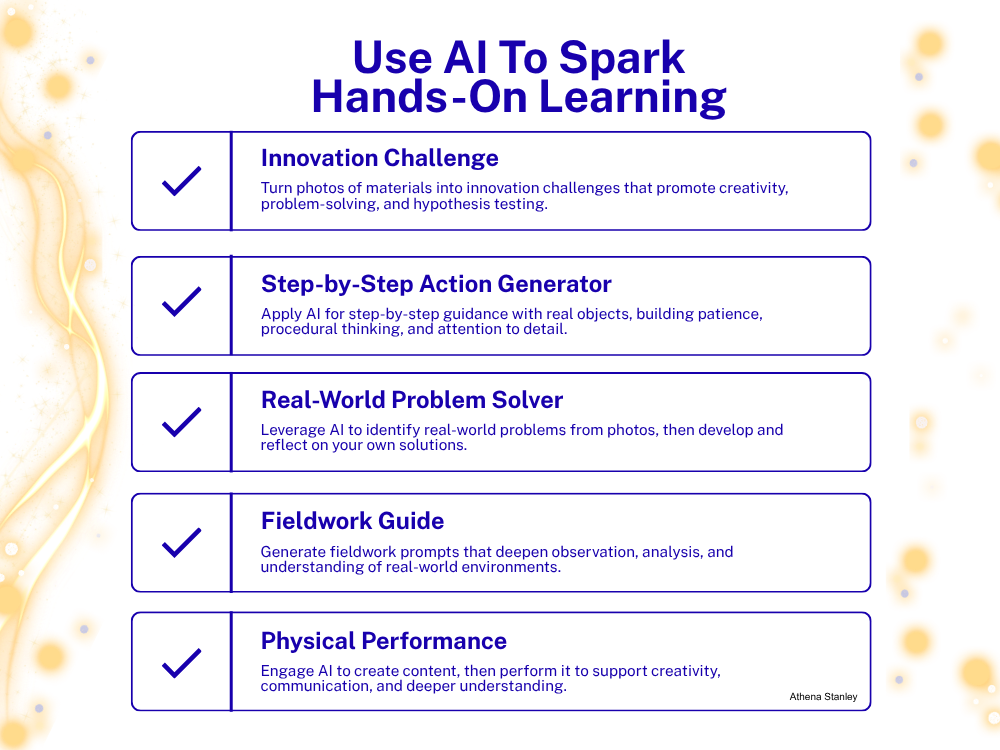
Teachers can deploy AI tools to move students away from screens and into physical environments where learning happens through direct observation and problem-solving.
One method involves having students photograph their surroundings—classroom, home, or community spaces—then use AI to identify problems without receiving immediate solutions. This approach combines technology with field investigation. Students become researchers in their own spaces, developing critical thinking before AI intervention occurs.
The strategy reflects a broader shift in K-12 education. Rather than treating AI as a replacement for hands-on work, educators increasingly view it as a catalyst for deeper engagement with the physical world. The screen becomes a tool for analysis, not the destination for learning.
Other applications include using AI to help students design solutions once problems are identified, creating feedback loops between observation and creation. Students might photograph community infrastructure issues, ask AI to categorize them, then prototype fixes using available materials. This sequence—observe, analyze with AI, design, build—mirrors how professionals actually work.
AI can also help document learning. Students photograph their hands-on projects and use AI to generate reflection prompts, helping them articulate what they learned and why. The technology becomes a thinking partner rather than an answer engine.
Teachers implementing these approaches report increased engagement. When students know they'll document their physical work with AI analysis afterward, they invest more attention in the tangible task itself. The camera becomes motivation for careful observation.
These methods address a persistent classroom challenge: students often treat assignments as digital tasks requiring minimal connection to real-world contexts. By anchoring AI use to observation and creation in physical spaces, teachers help students see technology as a bridge to authentic problems, not an escape from them.
The framework works across subjects. Science students might photograph and analyze local ecosystems. Social studies students can document community needs. Design and engineering classes gain a feedback mechanism that improves iteration cycles.
Success depends on clear instructions. Teachers must specify that AI identifies problems without solving