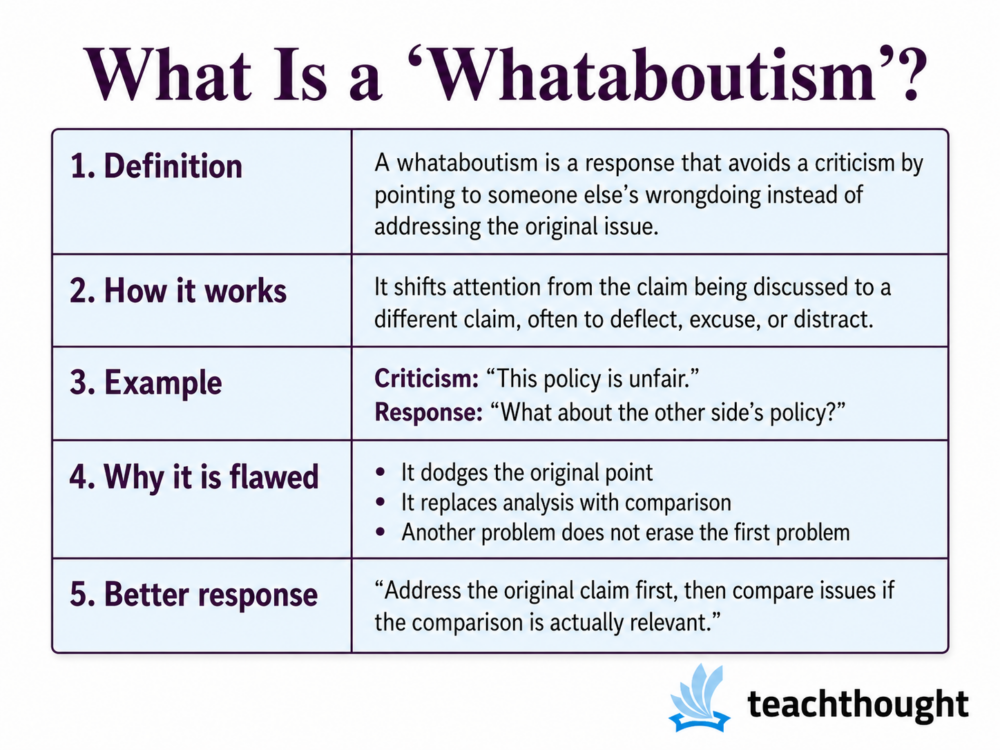
Whataboutism is a rhetorical technique that dodges direct responses by redirecting conversation toward an unrelated or tangential issue. Rather than engage with a specific claim or criticism, someone using whataboutism shifts focus to a different topic, often one that mirrors the original complaint.
The tactic frequently appears in political debates, social media arguments, and classroom discussions. In education settings, whataboutism can undermine productive dialogue. A student accused of plagiarism might respond with "What about the student who copied homework last week?" A teacher facing criticism about grading practices might counter with "What about parents who don't support learning at home?" These responses evade accountability rather than address the actual concern.
Teachers increasingly recognize whataboutism as a critical literacy issue. Students need to identify this deflection technique to evaluate arguments effectively and engage in genuine debate. Understanding whataboutism helps educators distinguish between legitimate counterpoints and evasive tactics in classroom discourse.
The term gained prominence in recent decades, though the strategy itself is centuries old. It appears across contexts where accountability matters: workplace interactions, policy discussions, and civic debates. Schools teaching media literacy and argumentation often include whataboutism in curricula exploring logical fallacies and persuasion techniques.
Recognizing whataboutism requires students to ask whether a response actually addresses the original claim. Does it engage with the specific evidence or concern raised? Or does it introduce a separate issue to avoid the question? Teaching this distinction builds critical thinking skills essential for navigating information-rich environments.
Education leaders view whataboutism literacy as part of broader media and digital citizenship instruction. When students understand how deflection works, they become more discerning consumers of arguments and more responsible participants in constructive dialogue. This skill extends beyond academics into civic participation and informed decision-making across domains.