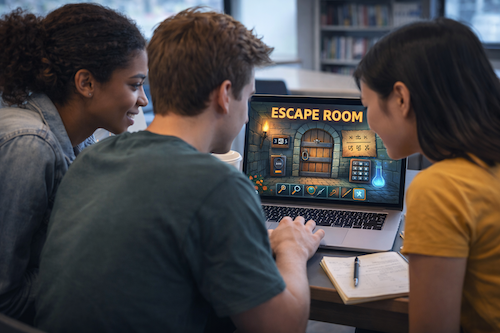
Escape rooms engage students through puzzle-solving and collaboration, but translating that energy into meaningful classroom learning requires intentional design. Educators looking to adapt escape room mechanics should focus on five key strategies.
First, align puzzles directly to learning objectives. Escape rooms work best when each challenge reinforces specific curriculum standards rather than serving as generic brain teasers. A math escape room should require students to apply equations to advance, not simply solve disconnected riddles.
Second, embed the Engineering Design Process and Process of Scientific Inquiry into room design. These frameworks ensure students don't just find answers. They develop systematic thinking. Students hypothesize, test solutions, iterate, and explain their reasoning. This transforms an escape room from entertainment into authentic learning.
Third, build in collaborative requirements that prevent individual students from dominating. Design puzzles that demand different skill sets. One student might excel at pattern recognition while another excels at reading comprehension. Every role matters to escape the room.
Fourth, keep time pressure moderate. While some urgency motivates engagement, excessive stress triggers anxiety and prevents deep thinking. Teachers should allow adequate time for students to work through problems without rushing.
Fifth, debrief meaningfully after the experience. Ask students which strategies worked, where they got stuck, and how they applied content knowledge. This reflection cements learning that the game alone cannot achieve.
Educators implementing escape rooms report increased student motivation and peer collaboration. However, the game mechanics alone don't guarantee learning gains. Teachers must intentionally connect gameplay to curriculum, ensure all students participate meaningfully, and facilitate reflection on what students learned.
Escape rooms work best as tools within a larger instructional strategy, not standalone activities. When designed with learning outcomes in mind, they create memorable experiences that stick with students beyond the final unlock.
WHY IT MATTERS: Escape rooms tap into student engagement, but educators need proven frameworks to transform entertainment into measurable