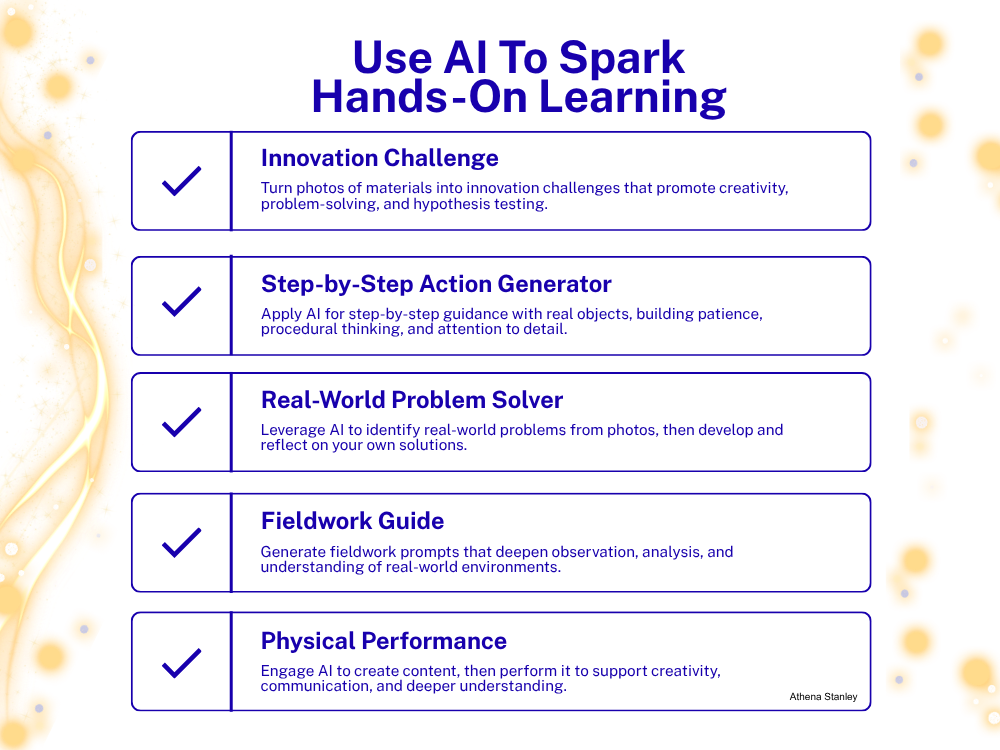
# From Screen to World: 5 Ways to Use AI to Spark Hands-On Learning in K–12 Classrooms
AI tools can bridge digital and physical learning when teachers design activities that push students beyond passive screen time. One effective approach asks students to photograph their actual surroundings, then use AI to identify environmental or structural problems without receiving ready-made answers. This method keeps students rooted in their communities while leveraging AI's analytical power.
The strategy works because it reverses typical AI use. Rather than asking the technology to solve problems, students use it to define them. A student might photograph a classroom hallway with poor lighting or a neighborhood intersection with traffic congestion, then ask an AI tool to identify inefficiencies or hazards. The AI names the problem. The student then owns the investigation, research, and potential solutions.
This approach addresses a real tension in K–12 education. Schools want students to develop critical thinking and tackle real problems. But many AI integration efforts trap learning inside interfaces, replacing textbooks with chatbots without changing the fundamental work. Students still sit and consume information.
Photo-based problem identification inverts that pattern. It begins with observation and moves outward. Students must understand their physical space deeply enough to frame a useful question. They engage with AI as a thinking partner, not an answer machine. They then apply findings to actual environments where people live, learn, and work.
Teachers implementing this approach report gains in student engagement and ownership. Students see connections between classroom learning and their neighborhoods. They develop agency. They recognize that identifying a problem often matters more than rushing to solve it.
The method also fits practical classroom constraints. It requires only a camera, an AI tool with image recognition, and thoughtful prompt design. No specialized equipment. No complex infrastructure. Teachers can start small, with one classroom or one grade level.
The framework extends across subjects. Science classes investigate environmental issues