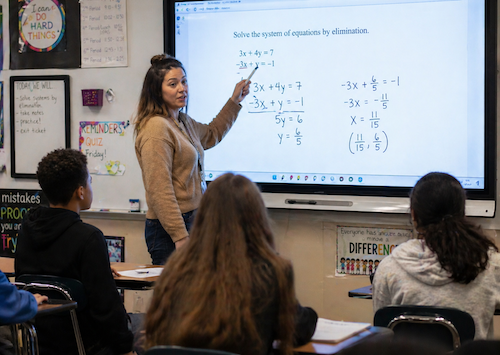
A veteran high school math teacher's experience in a professional learning session on early mathematics instruction prompted reflection on why students struggle with the subject. The teacher discovered gaps in foundational understanding that shaped their perspective on math instruction.
District leaders seeking to improve math outcomes now have four actionable lessons for building teacher confidence in the subject. These strategies emerge from research on professional development and classroom practice.
Teacher confidence directly shapes student outcomes in mathematics. When educators feel uncertain about content knowledge or instructional methods, that anxiety transfers to classrooms. Students pick up on hesitation and develop their own math anxiety.
The lessons for district leaders include investing in ongoing, targeted professional development rather than one-off workshops. Teachers need sustained learning focused on mathematical thinking and pedagogy, not just procedural skills. Collaboration matters too. Teachers who work together to examine student work and share strategies report higher confidence levels.
Districts should also prioritize early math instruction. Elementary math foundations determine high school success. Teachers who understand how young students develop number sense and conceptual understanding can build more robust teaching practices at every grade level.
Finally, leaders must create psychological safety. Teachers need permission to acknowledge knowledge gaps without fear of judgment. When districts normalize continuous learning and position professional development as growth rather than remediation, teachers engage more authentically.
The implications extend beyond test scores. A math classroom where teachers project confidence becomes a space where students take intellectual risks. Students ask questions. They persist through challenging problems. They develop resilience.
Building teacher confidence requires structural support from district leadership. Professional learning budgets, time for collaboration, access to math coaches, and instructional materials that reflect current research all factor into whether teachers develop confidence. District leaders who invest in these systems see shifts in classroom culture and student engagement.
The takeaway: math struggles often reflect teaching challenges, not student ability. When districts prioritize teacher learning and confidence, classrooms transform.
WHY IT MATTERS: Teacher confidence directly impacts