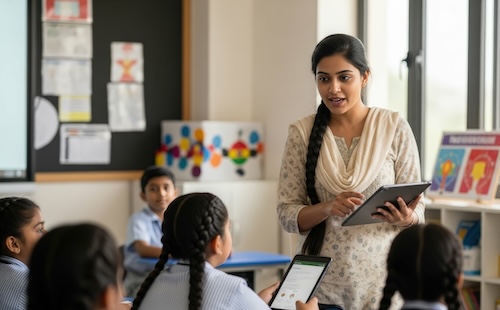
Teachers across the globe face a genuine tension: they want AI tools to improve lesson planning and free up time for meaningful instruction, yet they worry about expanding screen time in classrooms already saturated with devices.
A fifth-grade teacher in São Paulo articulated the dilemma during a professional development session. She sought ways to leverage AI for better lesson preparation without defaulting to another screen-based activity for students. This question echoes in classrooms from Brazil to beyond, reflecting educators' awareness that technology adoption carries real trade-offs.
The framing reveals what researchers and practitioners often overlook in screen-time debates. The conversation typically focuses on duration and harm, but misses the core issue: how teachers actually use technology to work smarter, not just differently.
Current discourse treats screen time as a monolithic variable. Twenty minutes on a poorly designed app differs fundamentally from twenty minutes on a tool that genuinely extends a teacher's capacity. AI can handle administrative work like creating differentiated worksheets, scaffolding lesson plans, or analyzing student work patterns. This frees educators to do what screens cannot: have one-on-one conversations, observe student confusion in real time, and adjust instruction based on immediate feedback.
The blind spot persists because policymakers and researchers rarely ask teachers what they actually need. Investment typically flows toward student-facing edtech products rather than teacher-augmentation tools. Schools accumulate devices but leave educators drowning in grading, planning, and paperwork.
This reframes the screen-time question entirely. The problem is not technology in classrooms. The problem is technology that adds to teachers' cognitive load rather than reducing it. A teacher using AI to write lesson plans works fewer hours and potentially delivers better instruction. Students using those refined lessons benefit without necessarily sitting passively at screens.
The São Paulo teacher's question suggests educators are ready to move past the "screens good or bad" debate toward something more